There are two similar Biblical stories.
The Book of Judges (4:17-22 and 5:24-31), tells of Yael, a Kenite woman, who kills Sisera, the commander of the Canaanite army, by driving a tent peg through his skull while he is sleeping.
Sisera is the leader of the Canaanite army under King Jabin around 1200 BC in the area of Hazor.

He is defeated by the Israelites led by the Prophetess Deborah and her general Barak.
During the battle, which goes disastrously for Sisera, he flees, seeking refuge in the tent of Heber the Kenite, who is at peace with King Jabin. Yael, Heber’s wife, receives Sisera, brings him milk, covers him; and when he sleeps, drives a tent peg through his skull.
Yael Tallit

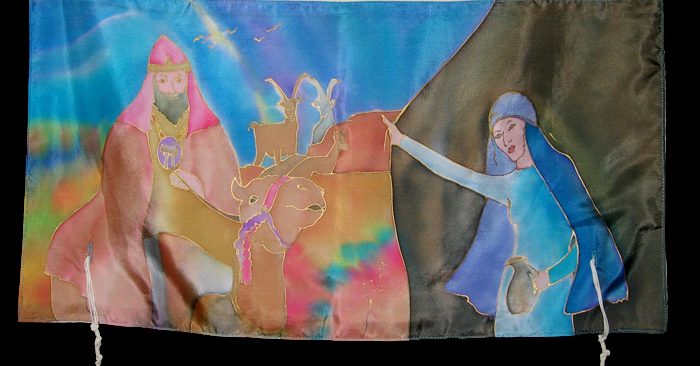
Yael Tallit Band I
Sisera approaches Yael’s tent.
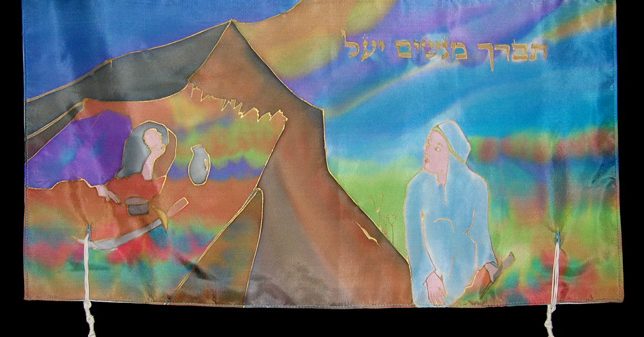
Yael Tallit Band II
When Sisera falls asleep,Yael drives a tent peg through his skull.
The second story is the Book of Judith, and was probably written in Hebrew, but survives only in Greek translation. It is not included in the Old Testament because it was written later. The Deuterocanonical books of the Bible, which refer to the books of the Bible written between the Old and New Testament periods, include the Book of Judith.
The information in the following paragraph comes from:
The work may have been written around 100 B.C., but its historical range is extraordinary. Within the reign of Nebuchadnezzar (1:1; 2:1), it telescopes five centuries of historical and geographical information with imaginary details. There are references to Nineveh, the Assyrian capital destroyed in 612 B.C., to Nebuchadnezzar, the ruler not of Assyria but of Babylon (605/604–562), and to the second Temple, built around 515. The postexilic period is presumed (e.g., governance by the High Priest). The Persian period is represented by two characters, Holofernes and Bagoas, who appear together in the military campaigns of Artaxerxes III Ochus (358–338); there seem to be allusions to the second-century Seleucid ruler Antiochus IV Epiphanes. Several mysteries remain: Judith herself, Arphaxad, and others are otherwise unknown. The geographical details, such as the narrow defile into Bethulia (an unidentified town which gives access to the heart of the land), are fanciful. The simple conclusion from these and other details is that the work is historical fiction, written to exalt God as Israel’s deliverer from foreign might, not by an army, but by means of a simple widow.
Scholars believe the Book if Judith was actually written during the Hashmonean revolt in the middle of the second century BCE to inspire those fighting for Jewish independence.
Judith’s ancestry goes back to the tribe of Simeon. Her husband, Manasseh, is only mentioned in relation to her and dies prior to the story. She lives in Bethulia; a pious woman still mourning her husband’s death over two years after the required year of bereavement. She is wealthy, beautiful, apparently without children, and not looking to remarry.
In the story, set in the sixth century BCE., Nebuchadnezzar, King of Babylon, wants to punish the nations who have failed to respond to his call for an alliance against the Medes and dispatches his general Holofernes to besiege the possibly fictional Judean city of Bethulia.
Thirty-four days pass under siege.
With their water supply cut, the besieged are beginning to lose hope.
Judith hears of plans to surrender to Holofernes’ army within five days if it does not rain.
She sends her maid to invite Uzziah, ruler of Bethulia, and the elders of Bethulia, to come to her home where she speaks with them.
She is confident that G-d will come to their aide; and she has a plan.

Judith speaking to Uzziah, ruler of Bethulia, and the elders of Bethulia
Uzziah agrees to wait five days for her to execute her plan.
Judith prays, bathes, anoints her body with perfume, dresses, and adorns herself with fine jewels. She instructs her maid to prepare food to take along for the journey. At the city gates she and her maid receive the blessing of the city elders.
Pretending to be defectors, they are brought by the Assyrian forces to the Babylonian camp, where Judith says she wishes to speak to Holofernes about a way to enter Bethulia and defeat it. Her plan is elaborate and takes a number of days, but ultimately Holofernes entertains her, drinks himself into a stupor, and is decapitated by her with his sword. She and her maid return to Bethulia with Holofernes’ head in a sack. It is hung on the city wall which ends the siege and scatters their enemies.
Judith never marries, and lives to age 105, in a time of peace.
This post is dedicated to my beloved niece, Jude Eden; and to my cherished friend, Yael Eshet.
 Israelcraft
Leave a comment