Weekly Biblical Portions
- Bereshit
- Noah
- Lech-Lecha
- Vayera
- Chai Sara
- Toldot
- Vayetze
- Vayishlach
- Vayeshev
- Miketz
- Vayigash
- Vayechi
Bereshit Tallit
Parasha Bereshit “In the Beginning” בְּרֵאשִׁית Genesis 1:1-6:8, is the 1st weekly Torah portion in the annual cycle of Torah reading beginning on Rosh Ha Shana, the Jewish New Year.
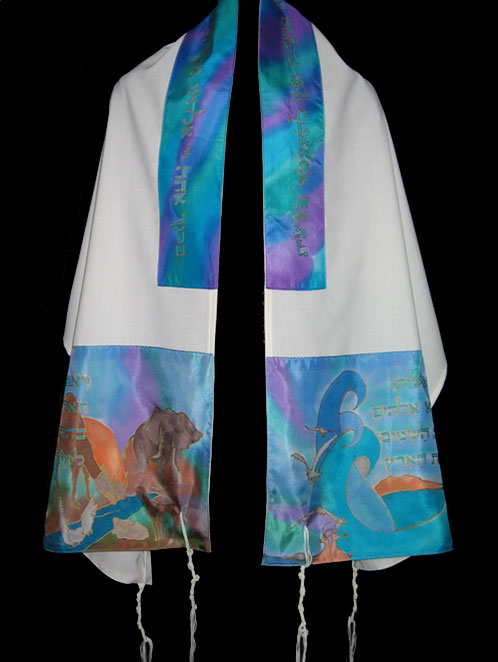
The first Bible portion is about the creation of the earth, sea, and light, and the creatures of the earth and sea.
On the first day, G-d creates light; on the second day, the sky; on the third, the earth, seas, and vegetation; on the fourth, the sun and moon; on the fifth, animals of the air and sea; on the sixth, land animals and Adam; and Eve from his rib.
G-d rests from his work on the seventh day, the Sabbath.
Adam and Eve eat from the Tree of Knowledge and are banished from the Garden of Eden.
Their elder son, Cain, kills his younger brother, Abel, and is destined to a life of wandering.
Bereshit Band I
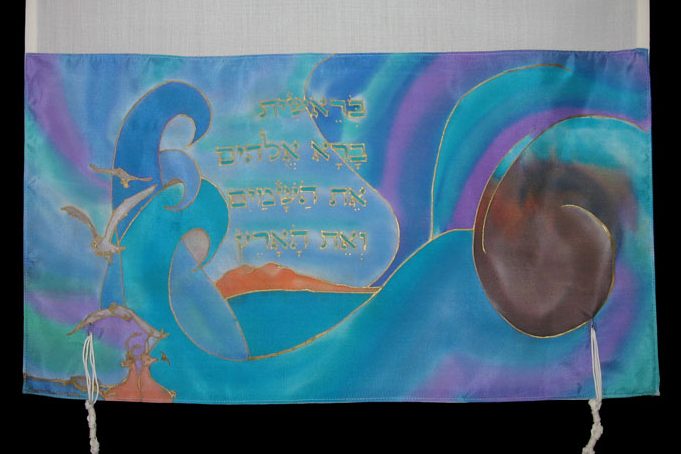
Bereshit Band I
This band is a telescoped view of the first five days of creation.
Translation of Hebrew (Genesis 1, 1):
“In the beginning God created the heaven and the earth.”
Bereshit Band II
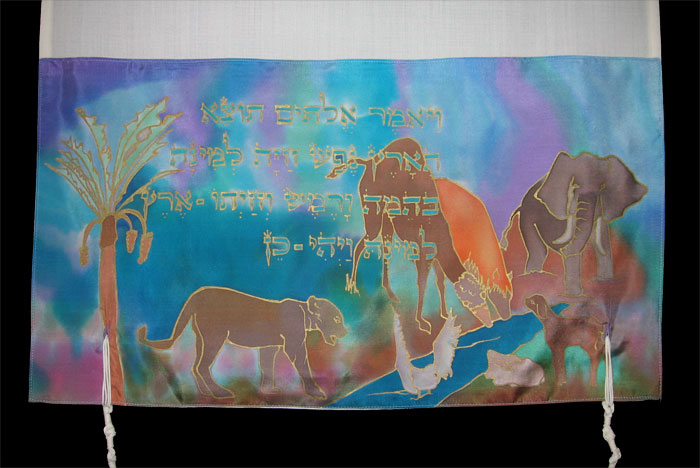
Bereshit Band II
Animals congregate in harmony in this pastoral scene.
Noah Tallit
Parashat Noah נֹח Genesis 6:9-11:32, is the 2nd weekly Torah portion in the annual Jewish cycle of Torah reading beginning on Rosh Ha Shana, the Jewish New Year.

It begins as G-d decides to destroy mankind with a Flood.
He gives Noah specific instructions in the making of an ark to save a remnant of humanity and all living animal species during the Flood.
G-d also confounds the speech of those building the Tower of Babel.
There is then a recounting of all the generations down to Abram ending with Terach, father of Abram, Nachor and Haran, whose son is Lot, in Ur Casdim.
Abram marries Sarai. Nachor marries Milcah, the daughter of Haran. Sarai is sterile. Terach travels with his son Abram, Sarai, and his grandson Lot, from Ur Casdim to Canaan. They settle in Charan.
Noah Tallit Band I
Band I
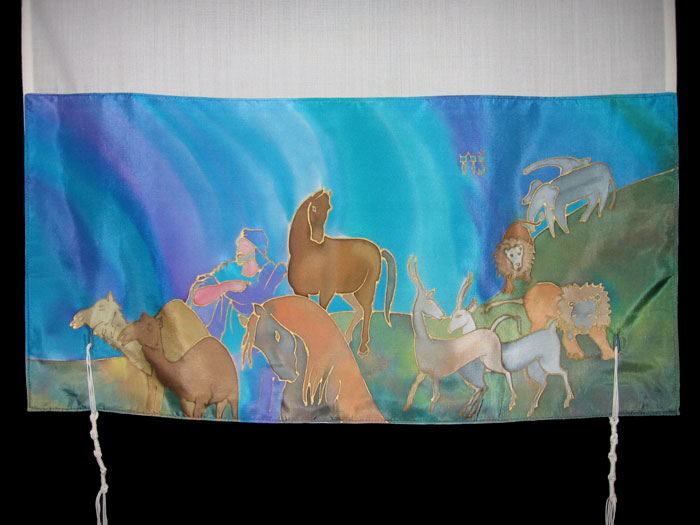
Noach leads horses onto the ark.
The detail of Noah is adapted from a Purim story lithograph of 18th century French lithographer Gustave Dore.
Noah Tallit Band II
Tallit Band II
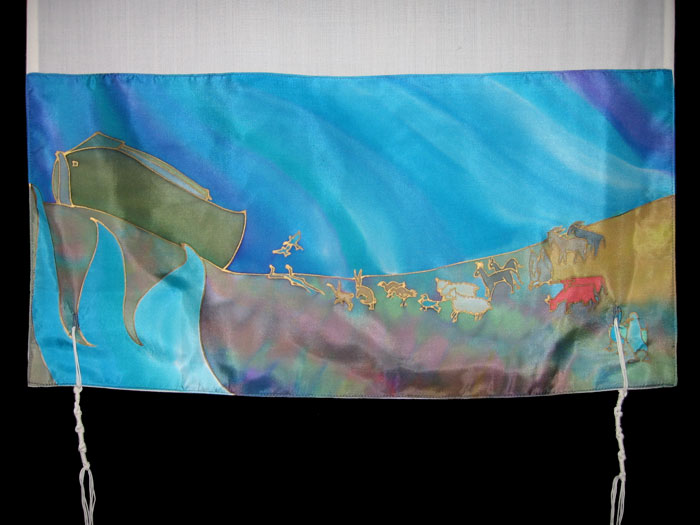
Animals approach the ark, two by two.
Lech Lecha Tallit
Parashat Lech-Lecha “Go Forth” לֶךְ־לְךָ
Genesis 12:1-17:27 is the 3rd weekly Torah portion in the annual Jewish cycle of Torah reading beginning on Rosh Ha Shana, the Jewish New Year.

It recounts Abram's first encounter with G-d, when his name becomes Abraham; his journey to Canaan which G-d promises him and his descendants as an everlasting possession; Abraham and Sara's time in Egypt; the birth of Ishmael; and
G-d's commandment of circumcision.
As to their time in Egypt; Abraham and Sara travel there due to famine.
Abraham fears the Egyptians will murder him for Sara, so he tells them  she is his sister.
Pharaoh does take her into his household, and as a result, Pharaoh is afflicted with plagues.
When he learns the reason for it is that he has taken another man’s wife, he returns Sara to Abraham, and orders them to leave, but not without enriching them with livestock, servants, silver, and gold.
Lech Lecha Band
Tallit Band I
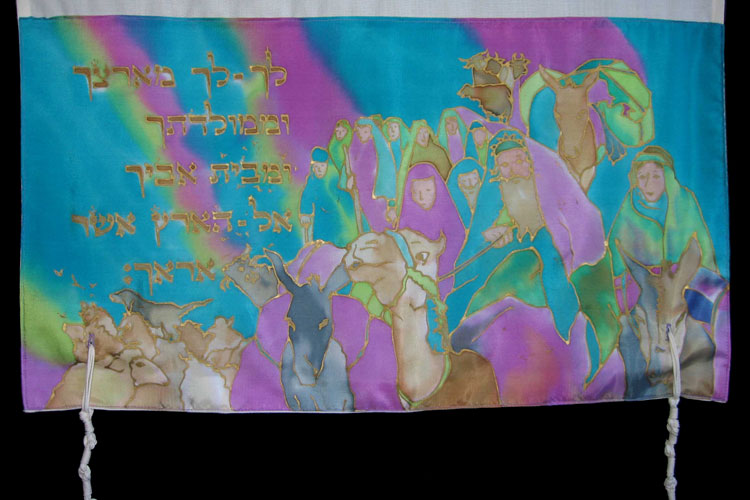
Abraham and his family travel west to the land of Canaan. Genesis 12:1
Translation of Hebrew “Get thee out of thy country and from thy kindred, and from they father’s house, unto the land that I will show thee.”
Lech Lecha Band
Tallit Band II
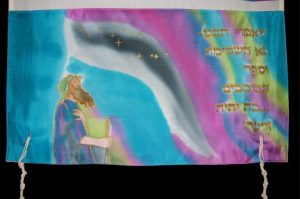
Abraham gazes at the stars. [The image of Abraham is taken from E.M. Lillian’s nineteenth century etching “Abraham Counts the Stars.”]
Vayera Tallit
Parashat Vayera “He Appeared” וַיֵּרָא
Genesis 18:1-22:24 is the 4th weekly Torah portion in the annual Jewish cycle of Torah reading beginning on Rosh Ha Shana, the Jewish New Year.

It begins as guests who are actually angels, tell Abraham that Sara will bear a child.
G-d then destroys Sodom and Gomorrah, but is convinced by Abraham not to destroy its inhabitants, of which his brother’s son, Lot, is one.
However, as Lot and his family are leaving, Lot’s wife looks back and is turned into a pillar of salt.
Isaac is born to Sara; and Hagar is later banished.
In conclusion, G-d commands that Abraham sacrifice Isaac.
However, in the eleventh hour he accepts a ram in his stead.
Vayera Band I
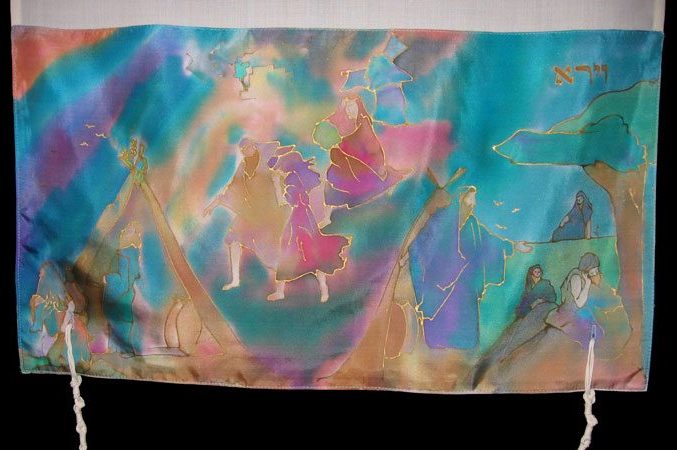
Band I Scene I takes place at the home of Abraham and Sarah, where they are receiving guests, who are, in fact, angels who bring Sarah the message that she is to have a child.
Band I Scene II is the destruction of Sodom. Lot and his daughters are escaping, but Lot’s wife, who looks back, has turned to stone.
Band I Scene III Abraham banishes Hagar and Ishmael.
Vayera Band II
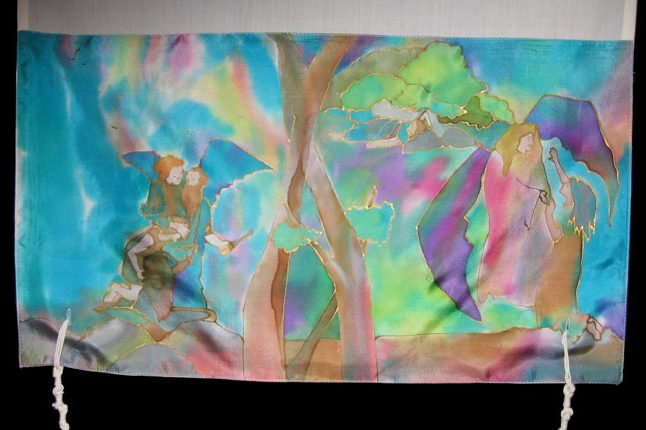
Band II Scene I is in the desert wilderness of Beersheba where Hagar and Ishmael have gone astray, and are about to die. An angel of God descends, rescues them, and promises her a nation.
Band II Scene II is the story of God’s test of Abraham and the sacrifice of Isaac. [The scene is based on a 1655 etching by Rembrandt.
Chai Sara Tallit
Chayei Sara “The Life of Sara”) חַיֵּי שָֹרָה
Genesis 23:1-25:18, is the 5th weekly Torah portion in the annual Jewish cycle of Torah reading beginning on Rosh Ha Shana, the Jewish New Year.
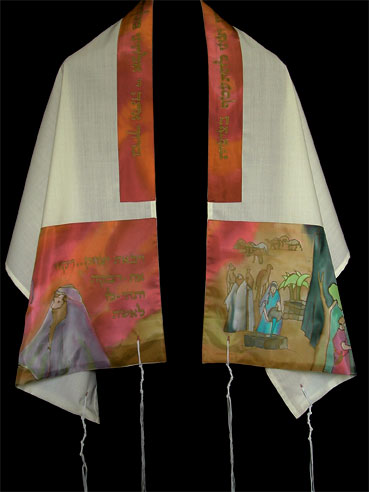
In Chai Sara Abraham successfully negotiates paying the full price for a burial plot for Abraham’s family at the cave of Machpelah where he buries Sara.
Then he turns his attention to finding a suitable wife for his son Isaac among his relatives in Aram Naharaim.
He sends his servant Eliezar to his brother, Nahor. On arrival, Rebecca is at a well where he stops to water his camels and she offers him a place to stay with her family.
After meeting Nahor and some formalities, Eliezar returns to Canaan with Rebecca, who becomes Isaac’s wife.
Abraham remarries, has more children, and dies at the age of 175.
Chai Sara Band I
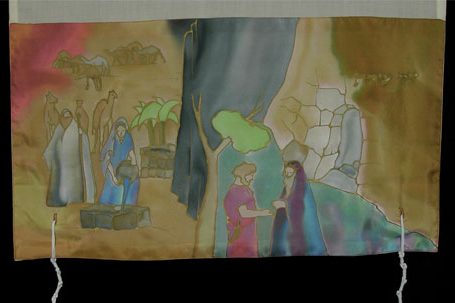
Band I Scene I shows Abraham buying a burial plot for Sara.
Band I Scene II has Eliezar watching Rebecca water his camels.
Chai Sara Band II
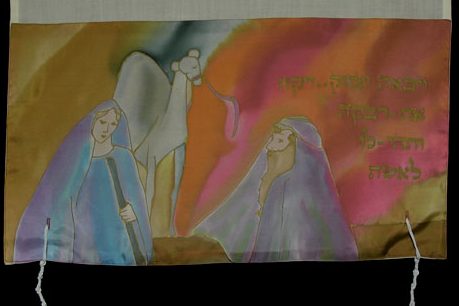
Band II Isaac takes Rebecca as his wife.
Toldot Tallit
Parasha Toldot תּוֹלְדוֹת “Generations”
Genesis 25:19-28:9 is the 6th weekly portion in the annual Jewish cycle of Torah reading beginning on Rosh Ha Shana, the Jewish New Year.
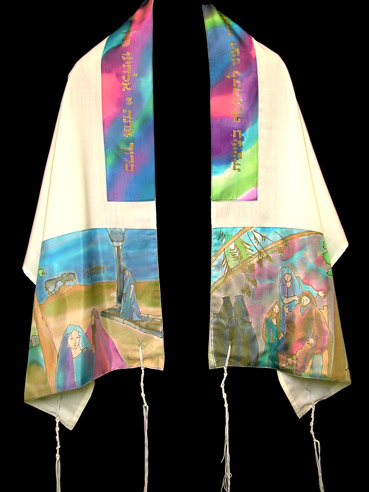
Toldot begins with Isaac's marriage to Rebecca and the birth of their twin sons, Jacob and Esau. There is a famine in the land and they go to Gerar where King Avimelech tries to take Rebecca as his wife, understanding that she is Abraham's sister. The incident ends with Isaac prospering there and living with Rebecca as his wife.
Later Isaac leaves the kingdom of Avimelech to live in the Valley of Gerar where he re-digs the wells dug in his father's day which had been plugged up by the Philistines after the death of Abraham. Disputes over water rights follow and Isaac settles, in the end, in Shibah (BeerSheva of today) where he gives his blessing to Jacob instead of Esau, and Jacob flees to avoid Esau's wrath.
Toldot Band I
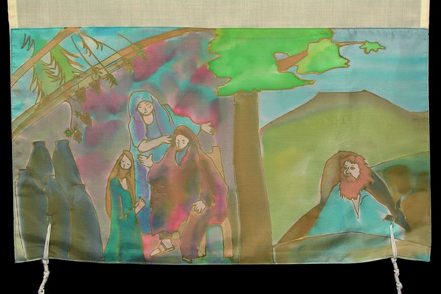
Toldot Band I Scene I
King Avimelech watches Abraham and Rebecca sporting and realizes they are man and wife.
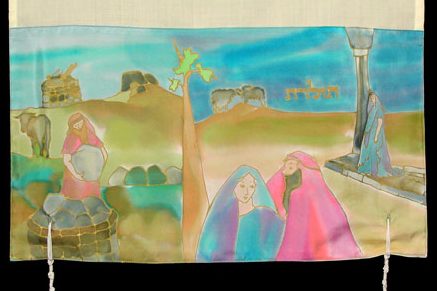
Toldot Band I Scene II
Isaac re-opens the wells that had been dug in the days of Abraham, and plugged up by the Philistines after Abraham’s death.
Toldot Band II
Toldot Tallit Band II
Isaac blessing Jacob, Rebecca looking on; his brother Esau nearby.
Vayetze Tallit
Vayetze “He Went Out” וַיֵּצֵא Genesis 28:10-32:3, is the 7th weekly Torah portion in the annual Jewish cycle of Torah reading beginning on Rosh Ha Shana, the Jewish New Year.
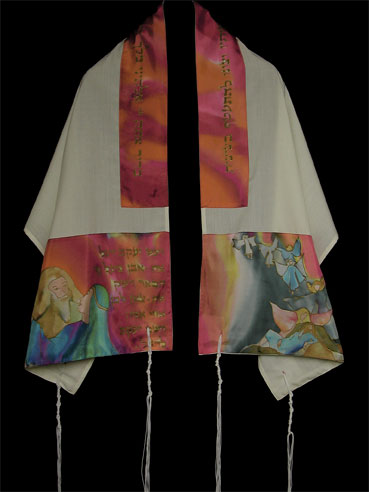
Jacob has left Be’er Sheva in fear of his life, after stealing his brother Esau’s birthright. He camps, and dreams of angels descending and ascending a ladder. G-d tells him he will give this land to him and his offspring. In thanks, Jacob builds an altar and calls it Bet El, the House of G-d. He then travels to his Rebecca’s brother, Laban, in Paddan-aram where he meets Rachel, Laban’s daughter, at a well where she is tending the family sheep. To marry her, he works seven years for Laban, only to find himself married to Rachel’s older sister Leah, instead. He works for Laban another seven years for the right to marry Rachel. Twenty years later he and his family return to Cannaan.
Vayetze Band I
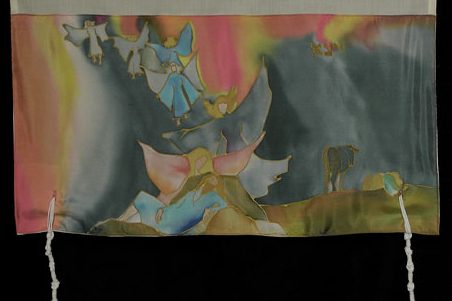
Band I, Jacob’s dream:
The figure of Jacob sleeping is taken from the painting “Mars and Venus” by early Renaissance Italian painter Sandro Botticelli 1445-1510.
Vayetze Band II
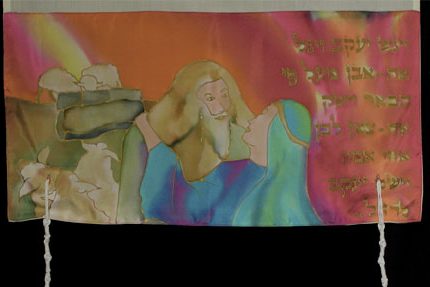
Band II, Jacob meets Rachel for the first time. Genesis, 29:10-11 Translation “…Jacob went near, and rolled the stone from the well’s mouth, and watered the flock of Laban his mother’s brother. (11) And Jacob kissed Rachel…”
Vayishlach Tallit
Vayishlach וַיִּשְׁלַח “He Sent” Genesis 32:4-36:43, is the 8th weekly portion in the annual Jewish cycle of Torah reading beginning on Rosh Ha Shana, the Jewish New Year.

In it, G-d has told Jacob to return to the land of his fathers after twenty years in Paddam-Aram serving his ungrateful Uncle, Laban, father of his wives, Rachel and Leah. He leaves for Gilead in Canaan with his family, livestock, and goods.
Fearing Esau may still want to kill him, he prepares lavish gifts for him.
Throughout the night before his meeting with Esau, Jacob struggles and is wounded by an angel, but does not let go of him until he receives his blessing and ias renamed Israel.
He is successfully reconciled with his brother, Esau.
Jacob’s daughter, Dinah, is raped by Shechem and then her brothers sack the city.
And lastly, Rachel dies during the childbirth of Benjamin.
Vayishlach Band I
Band I
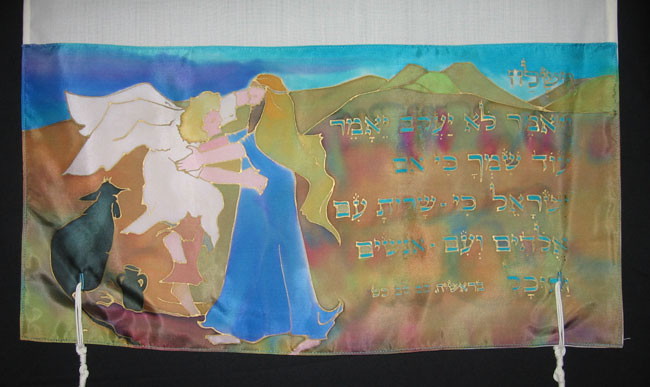
Jacob wrestles with an angel in the night, prevails, and is given the name Israel.
Translation of Hebrew (Bereshit 32, 29):
“And he (the angel Jacob was wrestling with) said: ‘Thy name shall be called no more Jacob, but Israel; for thou hast striven with God and with men, and hast prevailed.’ “
Vayishlach Band II
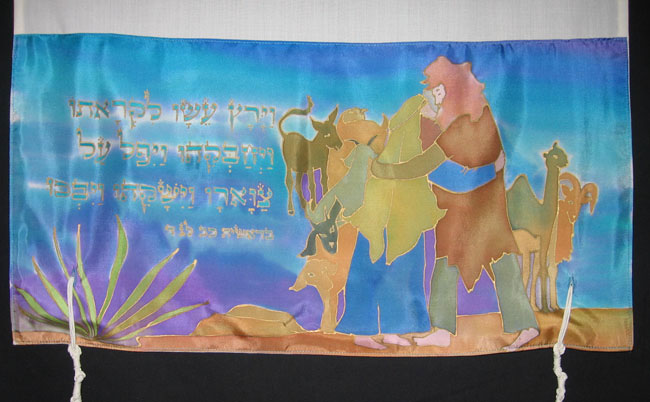
Band II
Jacob and Esau meet.
Translation of Hebrew (Bereshit 33, 4):
“And Esau ran to meet him, and embraced him, and fell on his neck and kissed him and they wept.
Vayeshev Tallit
Parasha Vayeshev “He Settled” וַיֵּשֶׁב Genesis 37:1-40:23, is the 9th weekly portion in the annual Jewish cycle of Torah reading beginning on Rosh Ha Shana, the Jewish New Year.
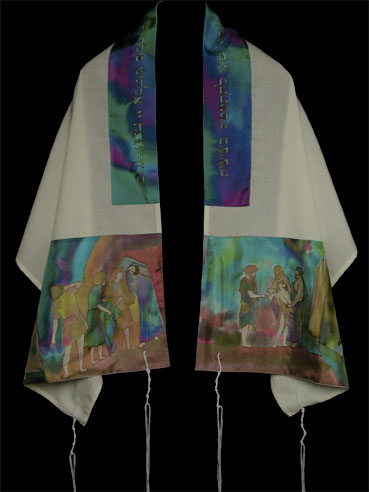
Joseph's dreams, his attitude, and the favoritism he is shown because he is Rachel's son, cause jealousy among his brothers. Joseph's father, Jacob, sends him to meet his brothers. Joseph wears his beautiful coat which only enflames his brothers, who consider murdering him, but settle on leaving him to die in a pit.
Meanwhile, his brothers bring his coat back to their father, Jacob, soaked in sheep's blood, and tell him Joseph has been slain. Joseph is sold, taken down to Egypt, and thrown into prison over an incident concerning King Potifer's wife. He continues to interpret dreams in prison.
Vayeshev Band I
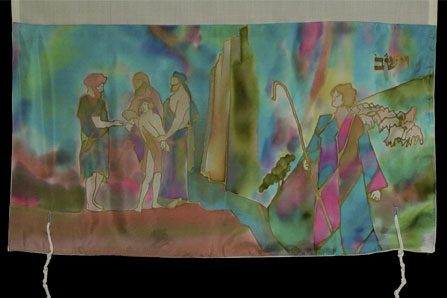
Vayeshev Band I Scene I shows Joseph as he goes to meet his brothers.
Vayeshev Band I Scene II shows Joseph sold into slavery by passing Medianites.
This scene is based on “Joseph Sold to the Merchants”, a nineteenth century painting by Hoppolyte Flandrin.
Vayeshev Band I
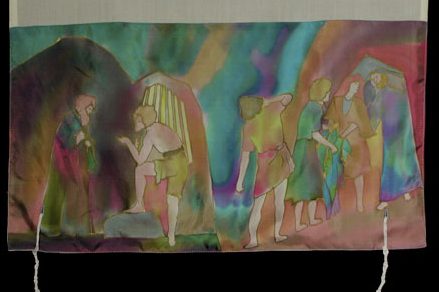
Vayeshev Band I Scene I shows Joseph as he goes to meet his brothers.
Vayeshev Band I Scene II shows Joseph sold into slavery by passing Medianites.
This scene is based on “Joseph Sold to the Merchants”, a nineteenth century painting by Hoppolyte Flandrin.
Miketz Tallit
Parasha Miketz “After” מִקֵּץ
Genesis 41:1-44:17, is the 10th weekly portion in the annual Jewish cycle of Torah reading.
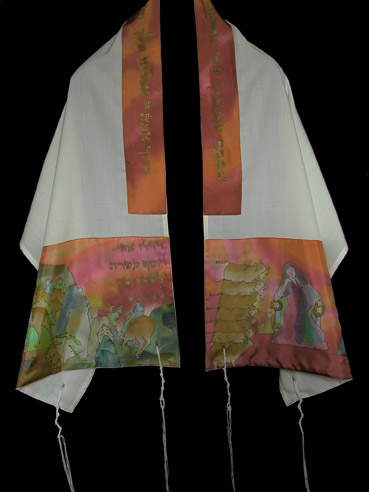
Miketz is the second parasha of four dealing with the story of Joseph. Joseph has made a name for himself interpreting dreams in prison in Egypt. None less than Pharaoh has a dream that troubles him, and Joseph is sought out to shed light on its meaning. Joseph interprets his dream, telling him of the coming famine. Pharaoh prepares himself and makes Joseph his right-hand man. Joseph's brothers come to him from Canaan, hoping for food, do not recognize him, and Joseph eventually tricks them into leaving Benjamin with him in Egypt.
Miketz Band I
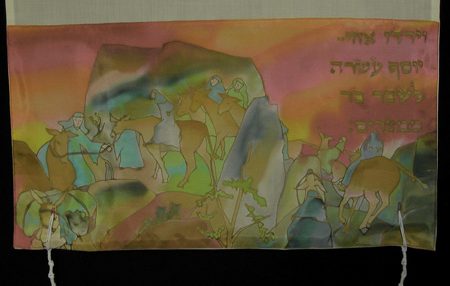
Miketz Band I
Joseph interprets Pharaoh’s dream
Miketz Band II
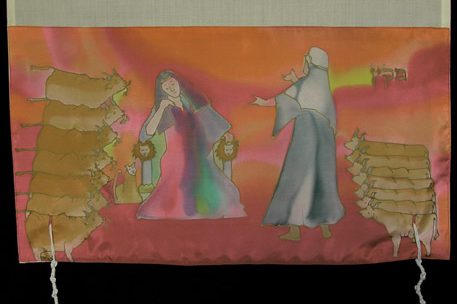
Miketz Band II
Joseph’s brothers travel to Egypt as there is famine in Canaan. Translation of Hebrew (Genesis 42, 3):
“And Joseph’s ten brethren went down to buy corn from Egypt.”
Vayigash Tallit
Parashat Vayigash “He Approached” וַיִּגַּשׁ
Genesis 44:18-47:27, is the 11th weekly portion in the annual Jewish cycle of Torah reading beginning on Rosh Ha Shana, the Jewish New Year.
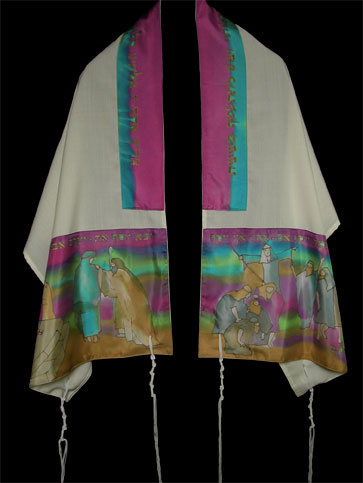
In it, over an incident of a supposed stolen chalice that Joseph has planted and later found in Benjamin's bag, Joseph finally reveals his identity to his brothers. Judah pleads to have Benjamin returned to their father and that he be kept hostage in his stead.
His brothers are dumbfounded with guilt at Joseph's revelation, but Joseph harbours no grudge against them and sees G-d's hand in the events which have ultimately ensured the survival of their family.
Joseph and his father, Jacob, reunite after 22 years, and Jacob is brought to meet Pharoah, who he blesses.
Jacob, his descendants, and all their flocks and herds and worldly goods, are brought to Goshen in Northern Egypt, where they settle.
Vayigash Band I
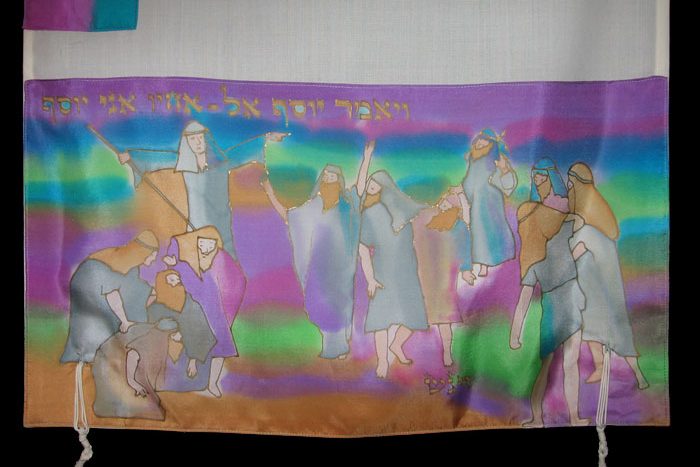
Vayigash Band I
Joseph reveals himself to his brothers.
Translation of Hebrew (Genesis 44, 3):
“And Joseph said unto his brethren: ‘I am Joseph.’ “
Vayigash Band II
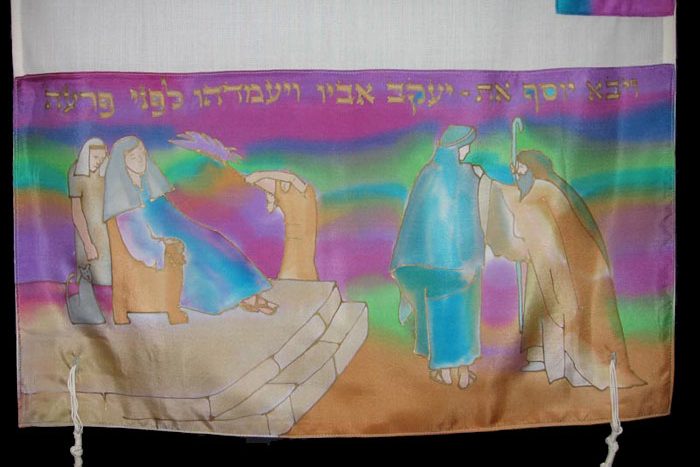
Vayigash Band II
Joseph introduces his father Jacob to Pharaoh.
Translation of Hebrew (Genesis 47, 7):
“And Joseph brought in Jacob his father, and set him before Pharaoh.”
[This scene is taken, in part, from a 19th century painting of Sir Edward John Poynter (1836-1919), “Jacob Introduces Jacob to Pharaoh”.]
Vayechi Tallit
Parashat Vayechi (“He Lived”) Genesis 47:28-50:26 is the final Torah portion in the Book of Genesis beginning on Rosh Ha Shana, the Jewish New Year.
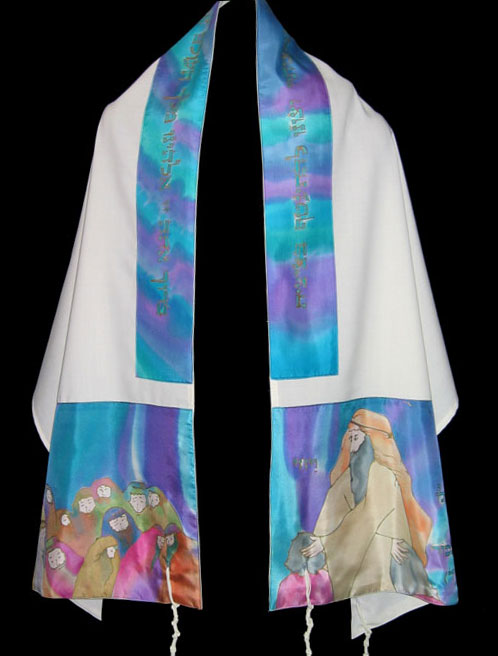
Jacob's family has been united and now he prepares to die. He tells his son Joseph that is sons, Efraim and Menasseh will be treated like Jacob's own sons. Then he blesses the younger Menasseh as the oldest, saying that the younger brother's seed will be greater than that of his older brother.
acob asks to be buried in the Cave of Machpelah in the land of his fathers, blesses his sons, and dies.
Vayechi Band I

Band I
Jacob blesses Ephraim and Manasseh. Genesis 48, 14:
Translation “And Israel stretched out his right hand, and laid it upon the head of Ephraim, who was the younger, and his left hand upon Manasseh’s head, guiding his hands wittingly; for Manasseh was the first-born.”
Vayechi Band I

Band II
Jacob’s sons gather together to receive his blessing.
Translation of Hebrew (Genesis 49, 1):
“And Jacob called unto his sons, and said: ‘Gather yourselves together, that I may tell you that which shall befall you in the end of days.’”ly; for Manasseh was the first-born.”
 Israelcraft