Weekly Biblical Portions
Shemot Tallit
Parashat Shemot “Names” שְׁמוֹת Exodus 1:1-6:1, is the first Torah portion in the Book of Exodus, the second Book of the Bible, and the 13th weekly portion in the yearly cycle of Torah reading beginning on Rosh Ha Shana, the Jewish New Year.
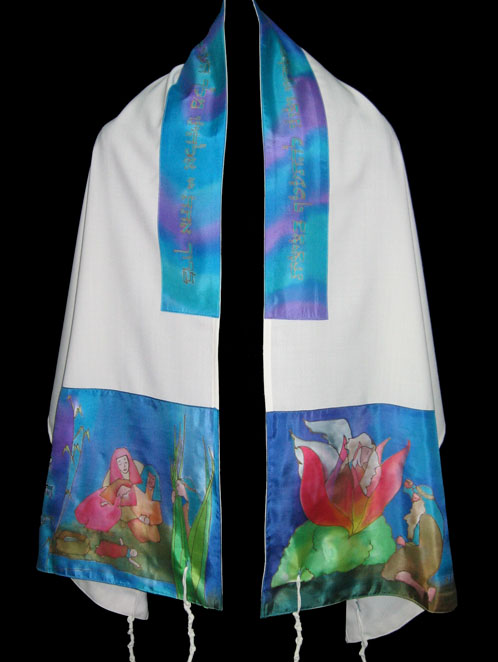
In Parasha Shemot, Moses is born, grows up and flees to Midian. In his wanderings as a shepherd, he encounters the burning bush and returns to free the enslaved Jewish Nation.
Shemot Tallit Band I
Tallit Band I
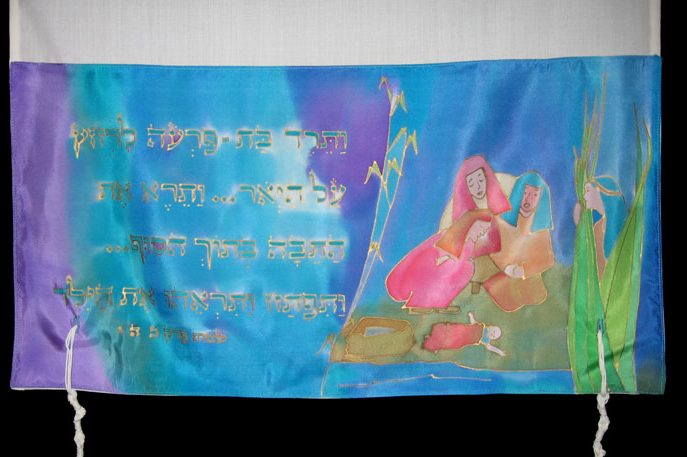
Moses is discovered by Pharaoh’s daughter, with Miriam looking on.
Translation of Hebrew (Shemot 2, 5-6):
“And the daughter of Pharaoh came down to bathe in the river…and she saw the ark among the flags…And she opened it, and saw…a boy…”
Shemot Tallit Band II
Tallit Band II
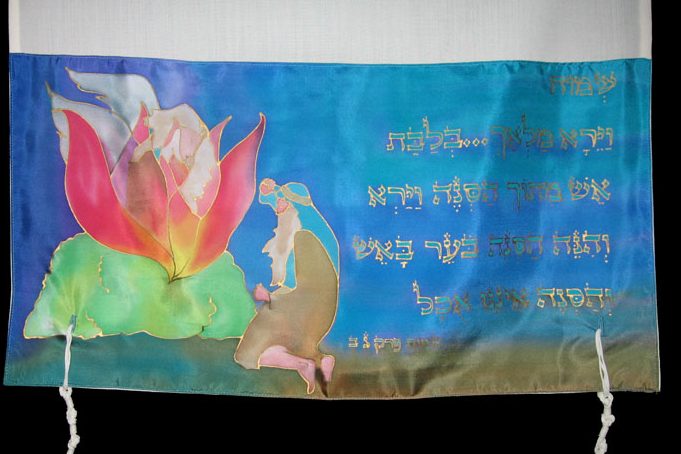
An angel appears to Moses in a burning bush, telling him to return to Egypt to bring the Israelites out of Egypt and into a land of milk and honey.
Translation of Hebrew (Shemot 3, 2):
“And the angel of the Lord appeared unto him [Moses] in a flame of fire out of the midst of a bush; and he looked, and the bush was not consumed.”
Vaera Tallit
Parasha Vaera Parashat Vaera “I Appeared” וָאֵרָא Exodus 6:2-9:35 is the 14th weekly Torah portion and the second portion of the Book of Exodus, the second Book of the Bible, which is read beginning on Rosh Ha Shana, the Jewish New Year.

In Parasha Vaera, Moses returns from Midian, and begins his mission to free the enslaved Israelites and bring them to Canaan.  He and his brother Aaron, attempt to convince the Pharaoh to free the enslaved Jewish nation.
8ut Pharaoh resists and the plagues begin: water turns to blood, Egypt is overrun with frogs, lice, and wild animals; livestock die, followed by an epidemic of boils, and the heaviest hail that Egypt has experienced.
But Pharaoh will not let them go.
Vaera Tallit Band I

Tallit Band I
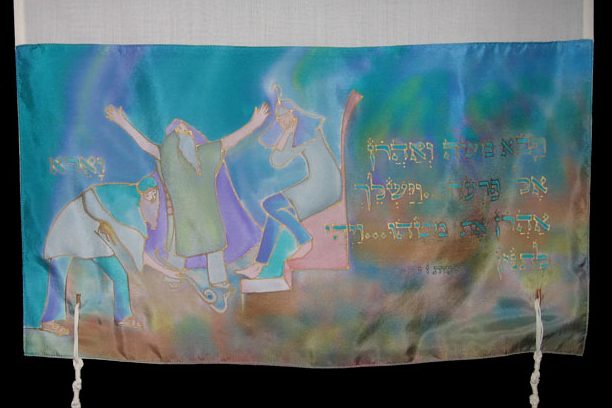
Aaron stands by the Nile, rod lifted, about to smote it and turn it to blood. Moses stands nearby, arms lifted to God in prayer.
Translation of Hebrew (Exodus 7, 20):
“And…Aaron did as the Lord commanded: and he lifted up the rod, and smote the waters that were in the river, in the site of the Pharaoh…and all the waters that were in the river were turned into blood.”
Vaera Tallit Band II
Tallit Band II
Aaron performs his first miracle, turning his rod into a serpent before Pharaoh.
Translation of Hebrew (Exodus 7 10):
“And Moses and Aaron went in unto Pharaoh, and they did so, as the Lord had commanded; and Aaron cast down his rod before Pharaoh… and it became a serpent.”
Bo Tallit
Parashat Bo “Come” בֹּא Exodus 10:1-13:16, is the Third Portion in the Book of Exodus, the second Book of the Five books of the Bible; which are read annually beginning on Rosh Ha Shana, the Jewish New Year.
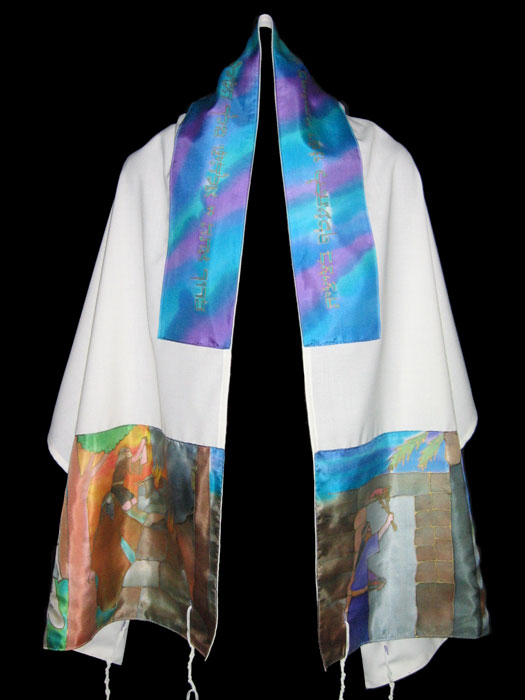
Parasha Bo deals with the first Passover. Lambs are brought and given as offerings; later that evening to be eaten at the first Passover. The Israelite dwellings are marked to keep them safe from the plague of the first born.
Bo Band I
Tallit Band I
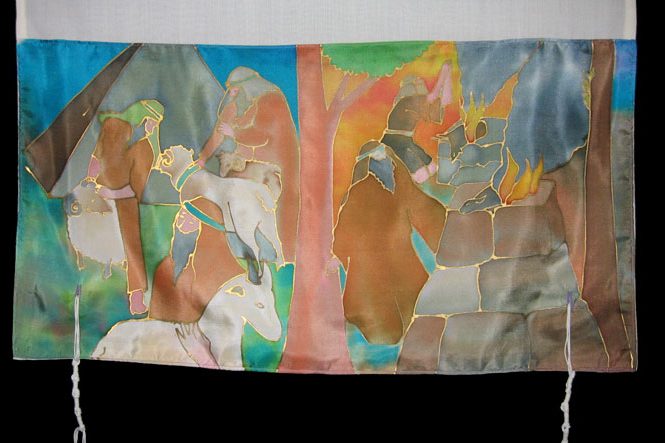
Band I Scene I
Lambs are brought, one per household.
Band I Scene II
At dusk the lambs are being offered on alters.
Bo Band II
Tallit Band II
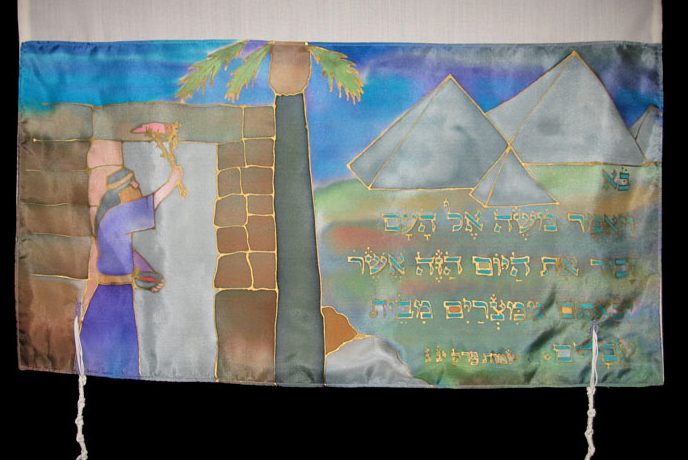
The entrance of an Israelite dwelling is marked, using a hyssop branch, to keep it safe from the plague of the first born.
Translation of Hebrew (Exodus 13, 3):
“And Moses said unto the people: ‘Remember this day, in which ye came out from Egypt, out of the house of bondage…”
Beshalach Tallit
Parashat Beshalach “When He Let Go” פָּרָשַׁת בְּשַׁלַּח Exodus 13:17-17:16, is the Fourth Portion in the Book of Exodus, the second Book of the Five books of the Bible which are read annually beginning on Rosh Ha Shana, the Jewish New Year.
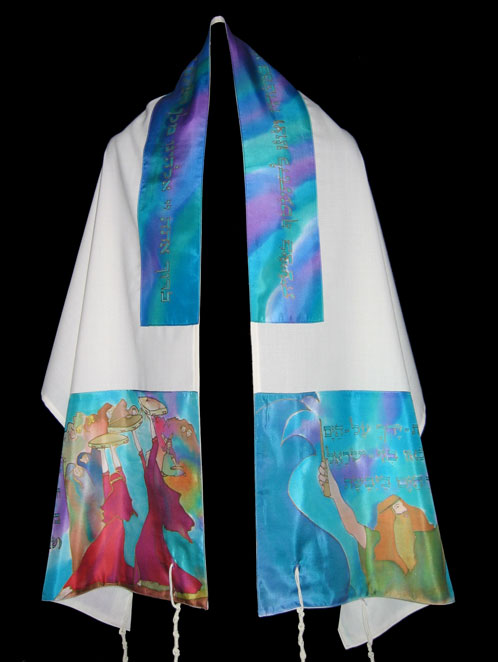
Parasha Beshalach tells of the escape of the Israelites from Egypt which they celebrate with Moses’ Song at the Sea and Miriam’s Song.
Beshalach Band I
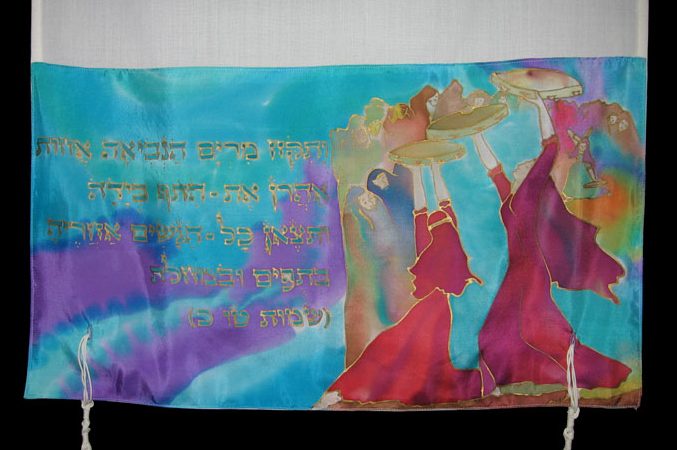
Tallit Band I
The prophetess Miriam, sister of Moses and Aaron, leads the dancing in celebration of the Red Sea crossing.
Translation of Hebrew (Exodus 15, 20):
“And Miriam the prophetess, the sister of Aaron, took a timbrel in her hand; and all the women went out after her with timbrels and with dances.”
Beshalach Band I
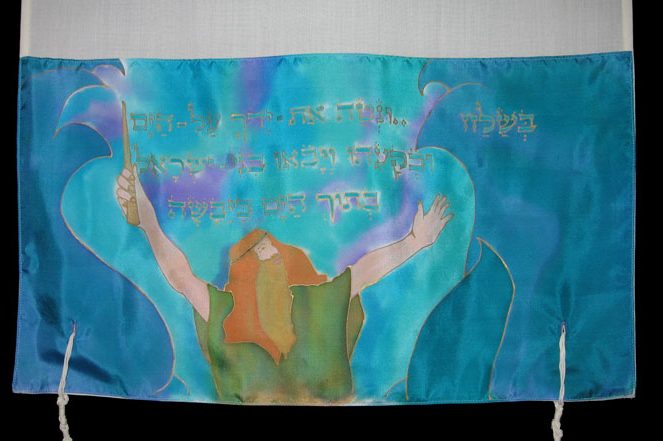
Tallit Band II
Moses divides the waters of the Red Sea.
Translation of Hebrew (Exodus 14, 16):
“Raise your staff and extend your hand over the sea. You will split the sea, and the Israelites will be able to cross over on dry land.”
Yitro Tallit
Parashat Yitro “Jethro” יִתְרוֹ Exodus 18:1-20:2 is the fifth Portion in the Book of Exodus, the second Book of the Five books of the Bible; which are read annually beginning on Rosh Ha Shana, the Jewish New Year.
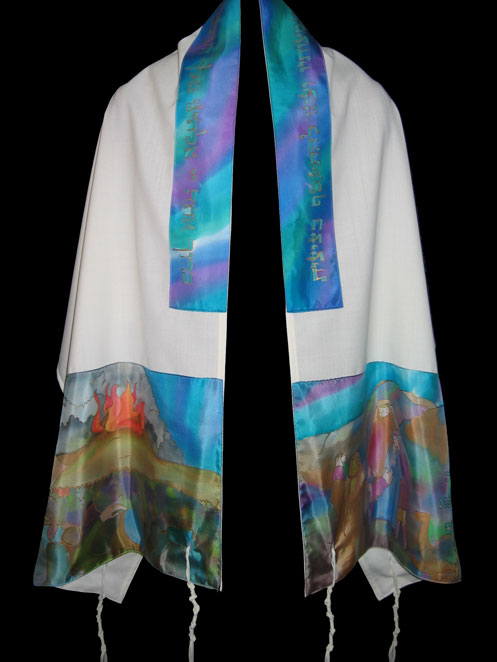
In Parashat Yitro, Moses’ wife Zipporah, her children, and her father Yitro, a Medianite priest, come to the Israelite’s camp at Mount Sinai where they gather to hear the Ten Commandments spoken by God.
Yitro Band I
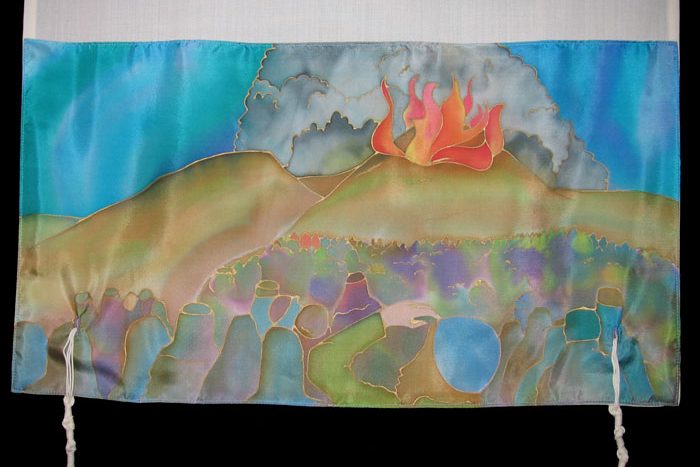
Tallit Band I
The Israelites congregate at the bottom of Mount Sinai, to hear the Ten Commandments being spoken by God.
Yitro Band II
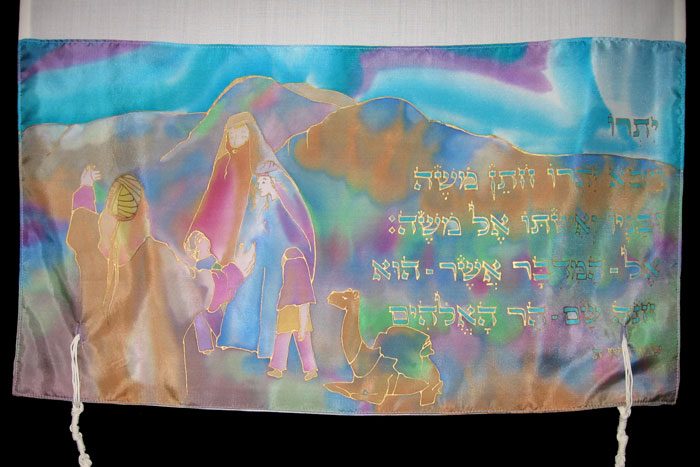
Tallit Band II
Moses welcomes his wife Zipporah, his father-in-law, Yitro, and his sons, Gershon and Eleazar.
Translation of Hebrew Exodus 17,5:
“And Yitro, Moses’ father-in-law, came with his sons and his wife unto Moses into the wilderness where he was encamped, at the Mount of G-d.
Mishpatim Tallit
Parashat Mishpatim “Laws” מִּשְׁפָּטִים Exodus 13:17-17:16, is the sixth portion in the Book of Exodus, the second Book of the Five books of the Bible, read annually, beginning on Rosh Ha Shana, the Jewish New Year.

In Parashat "Mishpatim", the Hebrew word for "laws", the congregation of Israel continues to hear the oral law spoken by God on Mount Sinai including the rights of bondsmen, laws concerning personal injury, murder, and property offenses. Also mentioned are the offering of the first fruits of the harvest and of young ox and sheep.
Mishpatim Band I
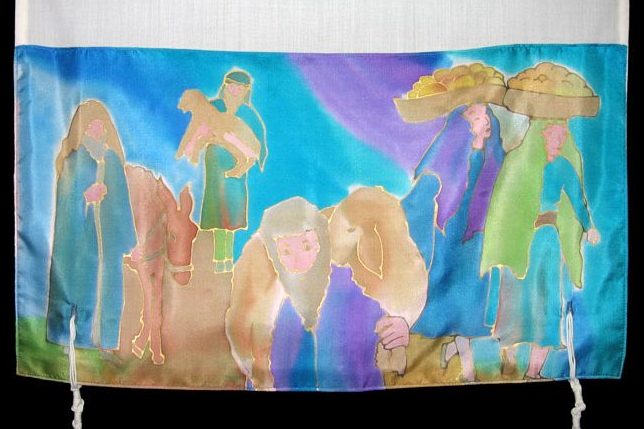
Tallit Band I
Women are bringing their offerings of the first fruits of the harvest, while men are bringing young sheep as offerings to be sacrificed to God.
Mishpatim Band I
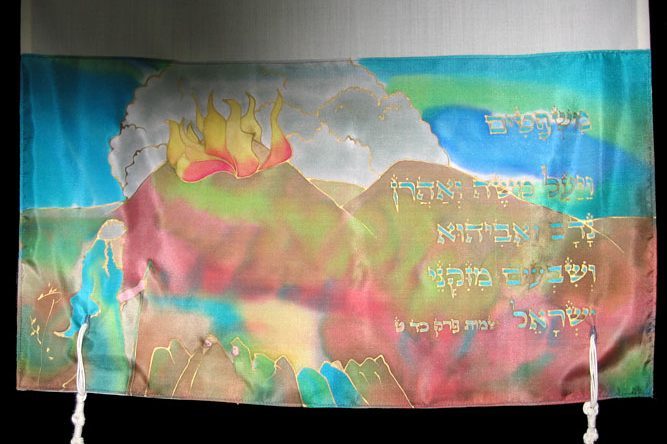
Tallit Band II
Moses ascends Mount Sinai with Aaron, Nabad, Abihu, and seventy of the elders of Israel who watch from afar.
Translation of Hebrew (Exodus 24, 9):
“Then went up Moses, and Aaron, Nadab, and Abihu, and seventy of the elders of Israel.”
Terumah Tallit
Parasha Terumah “Offering” פָּרָשַׁת תְּרוּמָה Exodus 25:1-27:19, is the Seventh Portion in the Book of Exodus, the second Book of the Five books of the Bible, and the 19th weekly portion in the yearly cycle of Torah reading beginning on Rosh Ha Shana, the Jewish New Year.

The subject of Parashat “Terumah”, the Hebrew word for “offering”, is the contributions that are to be made for the building of the Tabernacle and directions for erecting it.
Terumah Band I
Band I
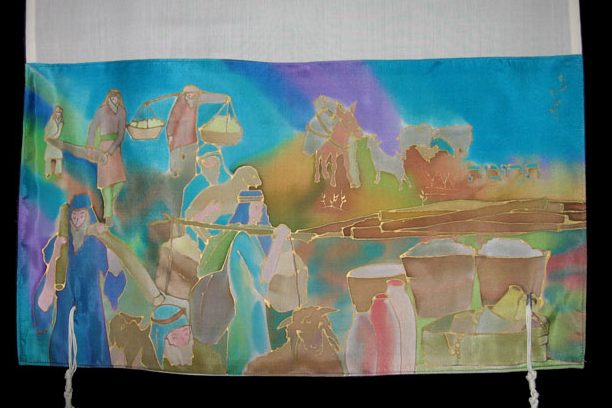
Offerings are being made for the building of the Tabernacle.
Terumah Band I

Tallit Band II
The Tabernacle has been erected and stands in all its glory.
Tezaveh Tallit
Parasha Tetzaveh “You Shall Command” פָּרָשַׁת תְּצַוֶּה Exodus 27:20-30:11, is the Eighth Portion in the Book of Exodus, the second Book of the Five books of the Bible, and the 20th weekly portion in the yearly cycle of Torah reading which are read annually beginning on Rosh Ha Shana, the Jewish New Year.
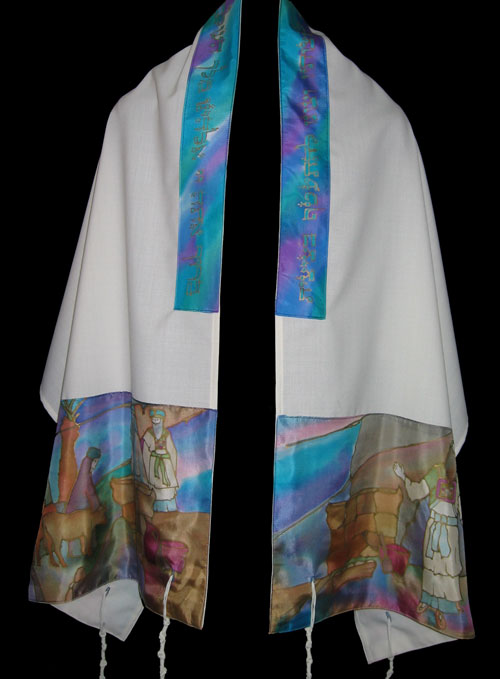
In Parasha Tetzaveh, God tells Moses in detail how to dress and anoint Aaron, the high priest, and his sons.
Tezaveh Band I
Tallit Band I
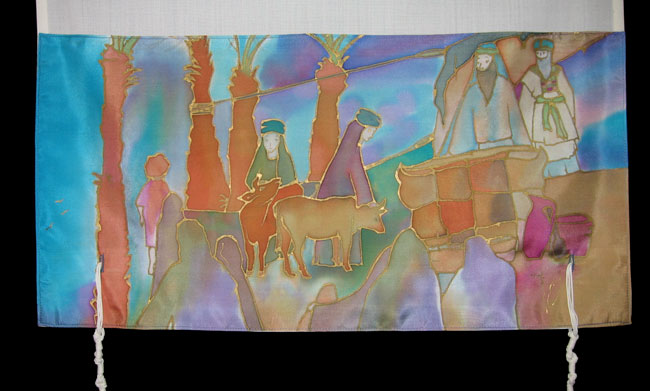
Aaron’s sons are laying their hands on bullocks being brought for a sin offering. Aaron, the high priest, is seen just inside, as is Moses, who is standing behind the alter.
Tezaveh Band I
Tallit Band II
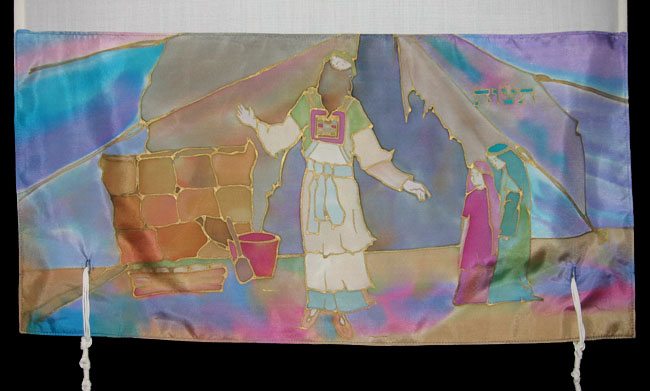
Aaron stands in front of the meeting tent in his newly made priestly garments.
Ki Tisa Tallit
Parasha Ki Tisa “When you rise above” פָּרָשַׁת כִּי תִשָּׂא Exodus 30:11-34:35, is the Ninth Portion in the Book of Exodus, the second Book of the Five books of the Bible, and the 21st weekly portion in the yearly cycle of Torah reading starting on Rosh Ha Shana, the Jewish New Year.
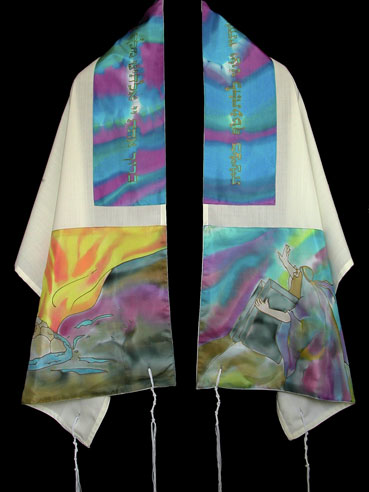
Parasha Ki Tisa is, in part, a continuation of the laws of the Sanctuary as given to Moses on reception of the tablets on Mount Sinai. But the people are anxious on his delayed return and make themselves a golden calf. Moses breaks the tablets, 3000 are slain over the incident, Moses goes back to Mount Sinai, speaks on behalf of the people, fasts for forty more days, and receives a second set of tablets.
Ki Tisa Band I
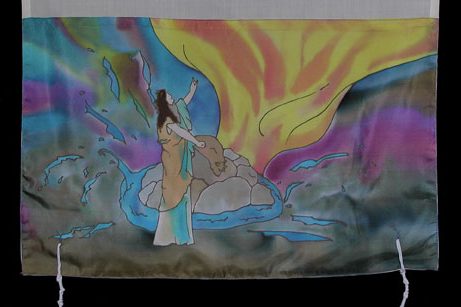
Tallit Band II
Haftorah Ki Tissa: Elijah and the false prophets are having a contest over which deity to worship, Baal or God. God sends fire to consume the elevation offering which burns, in spite of the water that Elijah has poured on it to drench the wood. We see fire descending from heaven and water splashing everywhere. It is based on the painting “Balaam Blesses Israel” by 19th century painter Hippolyte Flandrin.
Ki Tisa Band I
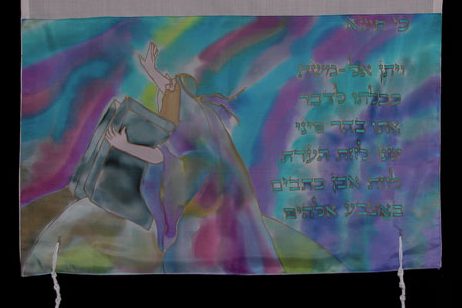
Tallit Band II
Moses receives the tablets on Mount Sinai.
Translation of Hebrew (Exodus 31, 18): “And He gave unto Moses, when He had made an end of speaking with him upon Mount Sinai, the two tables of the testimony, tables of stone, written with the finger of G-d.”
Vayachel Tallit
Parashat Vayakhel “He Assembled” פָּרָשַׁת וַיַּקְהֵל Exodus 35:1-38:20 is the tenth Torah portion in the Book of Exodus, the second Book of the Bible, and the 22nd weekly portion in the yearly cycle of Torah reading beginning on Rosh Ha Shana, the Jewish New Year.

Parashat Vayakhel opens as G-d commands the Israelites to observe the Sabbath, and refrain from labor and the kindling of fire. Moses asks for material donations for the building of the Tabernacle, which the people donate. Betzalel and Oholiav are designated by G-d to lead the artisans in building the articles sacred to the Tabernacle.
Vayachel Band I

Vayachel Band I
Offerings are being made for the building of the Tabernacle.
Vayachel Band I
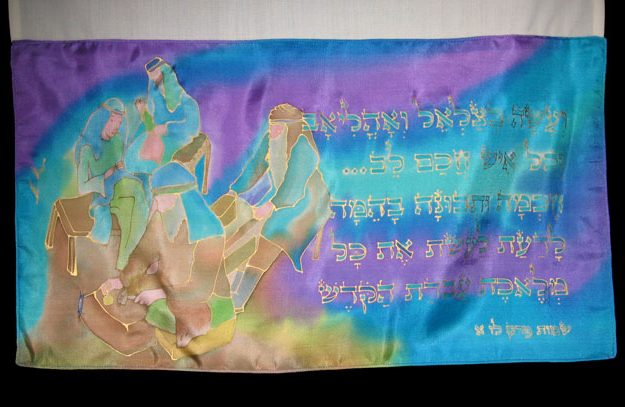
Vayachel Band II
Artists and craftsmen work on the Tabernacle and the sacred objects associated with it.
Translation of Hebrew (Exodus 36, 1):
“And Bezalel and Oholiab shall work, and every wise-hearted man, for the service of the sanctuary, according to all that the Lord hath commanded.”
Pekudei Tallit
Parashat Pekudei “Accountings Of” פָּרָשַׁת פְקוּדֵי Exodus 38:21-40:38, is the last Torah portion in Exodus, the 2nd Book of the five Books of the Bible, and the 23rd weekly Torah portion in the annual Jewish cycle of Torah reading which begins on Rosh Ha Shana, the Jewish New Year.

Parashat Pekudei describes the making of priestly garments worn in the Tabernacle and the completion of its construction. At God’s command, Moses erects its walls, pillars, connective pieces, tapestry coverings and curtains. He then puts its vessels in place, the menorah, ark, showbread table, altars, and washstand. The Tabernacle is then anointed and sanctified with oil, as are Aaron and his sons in their new priestly garments. Moses lights the menorah, arranges the showbread, burns incense, and makes a burnt offering and a meal offering. When all is done, the Tabernacle is filled with G-d's presence.

וַיְכַ֥ס הֶעָנָ֖ן אֶת־אֹ֣הֶל מוֹעֵ֑ד וּכְב֣וֹד יְהֹוָ֔ה מָלֵ֖א אֶת־הַמִּשְׁכָּֽן׃

Translation: the cloud covered the Tent of Meeting, and the Presence of G-d filled the Tabernacle.
Pekudei Band I
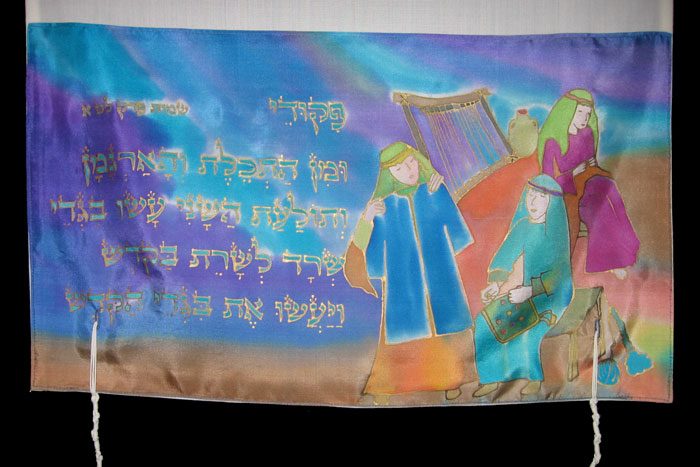
The ephod and priestly garments are being made.
Pekudei Band I
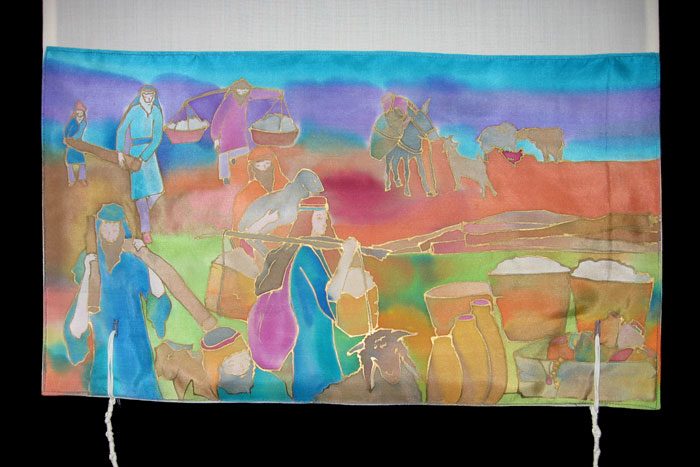
Pekudei Band II
Offerings are being made for the building of the Tabernacle.
 Israelcraft